
Cisco Reports AI-Driven Growth in Data Privacy Investment and Governance
TECHNOLOGY
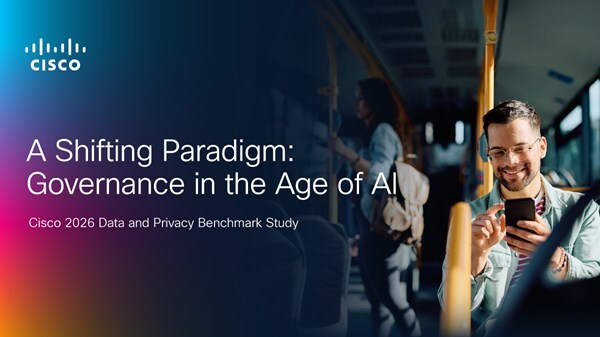

Cisco surveyed 5,200 IT, technology, and security professionals with data privacy responsibilities across 12 markets worldwide.
Data privacy was long viewed as a reactive requirement, a compliance task to be managed, not a value to be unlocked. Enter 2026, and the AI era has upended that mindset.
According to Cisco’s 2026 Data and Privacy Benchmark Study, which surveyed 5,200 professionals across 12 global markets, 90% of organizations have expanded their privacy programs specifically to meet the demands of AI.privacy is no longer a back-office concern; it is now central to powering and scaling AI innovation.
The $5 Million Milestone
The most visible sign of this shift is the budget. The report found that 38% of organizations spent at least $5 million on their privacy programs in the past year, a massive jump from just 14% in 2024. Furthermore, 93% of companies plan to increase that investment even further in the coming months.
This isn't just "throwing money at a problem." It is a strategic acknowledgment that without a mature privacy framework, the data required to power AI becomes a liability rather than an asset.
Mature vs. Merely Present
While the investment is there, the infrastructure is still catching up.
The Body: 3 in 4 organizations report having a dedicated AI governance body in place.
The Maturity: However, only 12% describe these governance structures as "mature."
The Data Quality: 65% of organizations admit they struggle to access the high-quality, relevant data needed to train effective AI models.
"AI is forcing a fundamental shift in the data landscape," said Jen Yokoyama, Senior Vice President at Cisco. "Organizations must deeply understand and structure their data to ensure every automated decision is explainable. It’s not just for compliance, but a necessary scaling engine for AI innovation."
The Localization Paradox
The study also highlighted a growing tension in global data flows. While 81% of organizations face heightened demand for data localization (keeping data within specific geographic borders), 85% say these requirements add significant cost and complexity to their operations. In fact, 77% report that localization limits their ability to offer seamless, 24/7 global services.
As a result, there is an overwhelming consensus (83%) that the world needs harmonized international data transfer rules to ensure AI can scale without breaking the global economy.
Transparency is the New Agility
In 2026, Transparency isn't a cost, it’s a competitive advantage. Cisco’s report proves that the organizations winning the AI race are those that treat privacy as a "Business Enabler."
For brands and leaders, the lesson is clear: if you want your AI to be "agile," your data must be "accountable." The "Black Box" era of AI is over; the future belongs to the "Open Book" organizations that can prove to their customers exactly how their data is being used, protected, and valued. In the Trust Economy, the most valuable data isn't the data you have, it’s the data your customers trust you with.
Related Stories
Lotti Media © 2025-2026
Lotti MEDIA is your go-to source for multi-industry insights, innovation, and more.
Stay in the Know
Join our mailing list today.
Powered by: Lotti Communications