
Despite Daily AI Use, Employees Still Seek Human Oversight, TeamViewer Finds
TECHNOLOGY
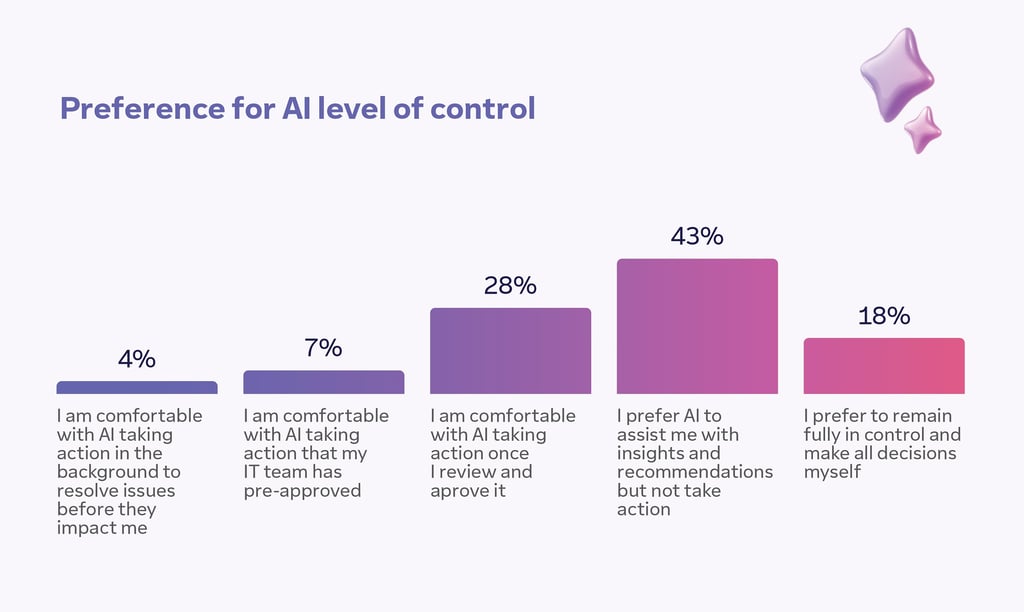
Preference for level of AI control based on global TeamViewer survey.
AI has become a routine part of modern work, but a new global study from TeamViewer shows that widespread daily use doesn’t automatically translate into trust. While 75% of employees use AI at least once a day, a significant 61% still want human oversight before AI takes action. This tension, between adoption and hesitation, highlights what TeamViewer calls the AI Confidence Gap, a barrier that could limit progress toward more autonomous digital workplaces.
AI Is Everywhere, And Mostly Welcome
The study, conducted across nine countries and 4,200 respondents, found that AI has already become deeply embedded in daily workflows.
75% use AI daily, and only 3% report no noticeable benefits.
64% describe their experience with AI as positive, suggesting that familiarity is growing.
Employees are comfortable with AI as a supportive tool, something they prompt, review, and rely on for efficiency. But comfort fades when AI begins acting independently.
The Rise of Autonomous Digital Workplaces
TeamViewer’s report, Path to the Autonomous Digital Workplace, explores the shift from AI assistance to AI autonomy. IT leaders, in particular, are preparing for a future where systems detect issues, make decisions, and take action with minimal human involvement.
26% of IT leaders say their departments are already at least partially autonomous.
99% would delegate at least one IT task to AI, especially routine work like system updates or device performance adjustments.
By 2030, leaders expect nearly 40% of digital workplace services to run autonomously.
This readiness reflects how quickly IT operations are evolving, and how well-suited they are for early autonomous adoption.
Trust Drops as AI Gains Authority
Despite enthusiasm for AI’s potential, most employees want guardrails.
61% prefer AI take no independent action without human approval.
Only 5% have no concerns about AI operating without human involvement.
70% are comfortable with autonomous AI only if they can intervene when needed.
The message is clear: people don’t reject autonomy, they reject invisible autonomy.
Guardrails Build Confidence
Respondents identified several safeguards that would make autonomous AI more acceptable:
Strong security and privacy protections (39%)
Notifications before major changes (36%)
Limits on data access (36%)
Visible activity logs (33%)
Rollback options (31%)
These preferences show that transparency and accountability, not speed, are the real drivers of trust.
AI Will Reshape Work, Not Replace It
Contrary to common fears, employees don’t expect AI to eliminate their roles.
33% expect AI to assist while they continue doing most tasks.
28% expect to delegate more tasks and focus on higher-value work.
Only 2% believe AI will fully replace their job by 2030.
The real challenge isn’t job loss, it’s the verification burden. More than half of respondents spend time each week double-checking AI outputs, unsure when to trust the system.
The Road Ahead: Trusted Autonomy
TeamViewer leaders argue that the next wave of productivity will come from trusted autonomy, not unchecked automation. Systems must be designed to act safely within clear boundaries, keep people informed, and escalate decisions when human judgment is needed.
As organizations push toward autonomous digital workplaces, closing the AI Confidence Gap will be essential. Employees are ready for AI to help, but they want to stay in control.
Related Stories
Lotti Media © 2025-2026
Lotti MEDIA is your go-to source for multi-industry insights, innovation, and more.
Stay in the Know
Join our mailing list today.
Powered by: Lotti Communications