
Report Shows Tech Hiring Shows Measured Improvement in Q2 2026
TECHNOLOGY
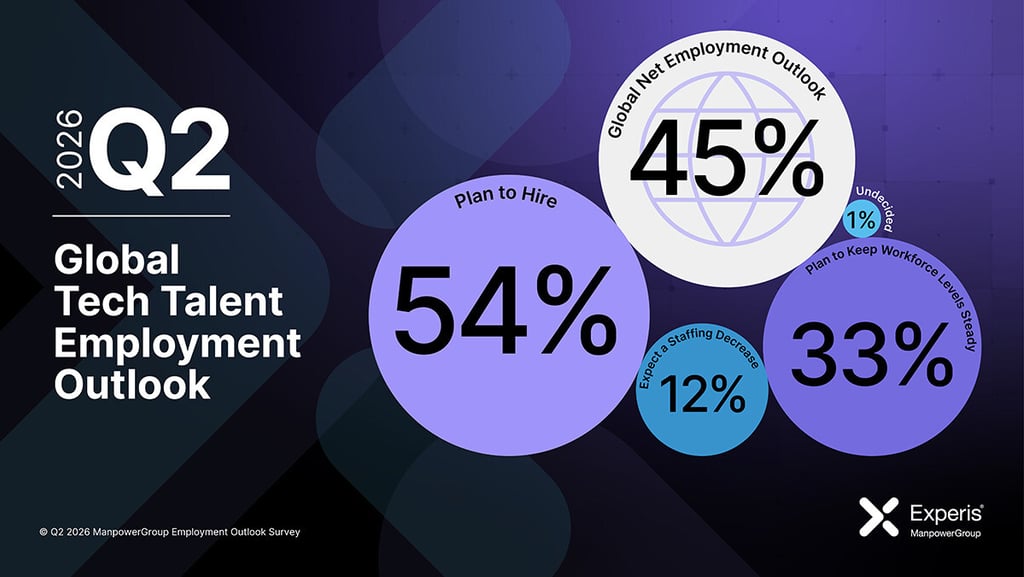
The latest Experis Tech Talent Outlook highlights steady demand for specialized tech skills, with U.S. hiring plans stabilizing after recent slowdowns.
Tech hiring in the United States is stabilizing after a period of moderation, with employers reporting a Q2 2026 Net Employment Outlook of 41 percent, an eight-point increase from the prior quarter, according to the latest Tech Talent Outlook from Experis, part of the ManpowerGroup family of brands. The improvement suggests growing employer confidence as technology investments continue across industries, though the U.S. outlook remains five points below year-ago levels.
The data for the second quarter was collected between January 1 and February 3, 2026. The findings reflect employer sentiment at the time of data collection and may not capture the potential impact of subsequent events.
Global Demand Remains Strong
Globally, tech employers report a Q2 Net Employment Outlook of 45 percent, up four points from the previous quarter and nine points year-over-year, reflecting sustained demand for tech talent. The U.S. outlook trails the global average, consistent with other mature tech economies where precision hiring has replaced broad-based expansion.
Skills shortages remain a constraint. Seventy-three percent of tech employers globally report difficulty finding the skilled talent they need, a slight improvement from 76 percent a year ago. Seventy-four percent of U.S. employers report challenges filling tech roles. The most acute gaps are in artificial intelligence capabilities alongside core human skills such as professionalism and work ethic.
"Across the global tech economy, demand for specialized talent remains high, but the nature of hiring has fundamentally changed," said Kye Mitchell, President of Experis U.S. "Employers are moving away from broad-based expansion and toward a more deliberate, skills-first approach. In the U.S., the quarter-over-quarter improvement suggests stabilization, while organizations continue focusing on securing specialized expertise, particularly in AI, and strengthening the human capabilities that support long-term business performance."
Workforce Strategies
To address ongoing talent scarcity, employers are adopting multiple workforce strategies. Globally, the most common actions include upskilling and reskilling current employees (30 percent), offering more work location flexibility (24 percent), increasing wages (22 percent), targeting new and underrepresented talent pools (22 percent), and offering more schedule flexibility (21 percent).
U.S. employers report similar priorities: upskilling and reskilling current employees (29 percent), increasing wages (28 percent), targeting new and underrepresented talent pools (28 percent), offering more schedule flexibility (23 percent), and using AI or automation to reduce staffing needs (22 percent).
Regional Variations
Tech hiring expectations vary significantly across geographies, with high-growth markets continuing to outpace more established tech economies.
Asia Pacific leads global tech hiring confidence. India reports the strongest outlook worldwide at 69 percent, reflecting robust demand for AI and digital transformation talent. Vietnam, participating in the survey for the first time this quarter, reports an outlook of 49 percent. Australia reflects more moderate intentions at 37 percent.
The Americas show broad-based improvement. Brazil leads with an outlook of 63 percent, followed by Panama at 61 percent and Canada at 45 percent. Colombia at 13 percent reflects more cautious employer sentiment, underscoring the uneven pace of tech hiring recovery across the region.
Europe and the Middle East presents a mixed picture. The United Arab Emirates leads the region at 69 percent, followed by Portugal at 50 percent and the Netherlands at 48 percent. Romania at 3 percent and Switzerland at 8 percent report the weakest outlooks globally, reflecting continued caution in parts of Central and Eastern Europe amid broader economic uncertainty.
Outlook for Tech Professionals
For tech professionals with in-demand expertise, opportunities remain strong across markets. Employers are increasingly prioritizing candidates with specialized capabilities in AI, cloud, and data, alongside the human skills needed to collaborate, adapt, and deliver business impact in rapidly evolving digital environments.
The survey is based on results from the ManpowerGroup Employment Outlook Survey, the longest running and most comprehensive forward-looking employment survey of its kind. ManpowerGroup interviewed 4,655 Tech and IT Services employers across 42 countries on hiring intentions for the second quarter of 2026. Survey responses were collected from January 1 to February 3, 2026.
The findings indicate that while tech hiring patterns vary by region and maturity of market, sustained demand for specialized skills continues to drive employer strategies worldwide. The measured improvement in the U.S. market suggests stabilization after recent moderation, while global momentum remains strong particularly in high-growth economies investing heavily in digital transformation.
The next report covering Q3 2026 hiring expectations will be released in June 2026. The full Tech Talent Outlook is available at experis.com.
Related Stories
Lotti Media © 2025-2026
Lotti MEDIA is your go-to source for multi-industry insights, innovation, and more.
Stay in the Know
Join our mailing list today.
Powered by: Lotti Communications