
Study Shows Americans Shift Weight Loss Focus from Beach Bodies to Metabolic Health
HEALTH & BEAUTY
aytm survey of U.S. adults shows consumers are pivoting from short-term aesthetics to metabolic longevity.
Weight loss goals are undergoing a fundamental transformation. A new survey of 1,000 U.S. adults who tried to lose weight in the past six months reveals a dramatic shift away from appearance-driven motivations toward long-term metabolic health, reshaping how Americans eat, shop, and view prescription medications.
The research, conducted by aytm in September 2025, shows consumers making diet changes that stick, rethinking their snack choices, and increasingly viewing GLP-1 medications as a legitimate tool rather than a last resort. These findings point to behavioral changes that are reshaping food retail, restaurants, and the pharmaceutical industry.
Health Outcomes Trump Aesthetic Goals
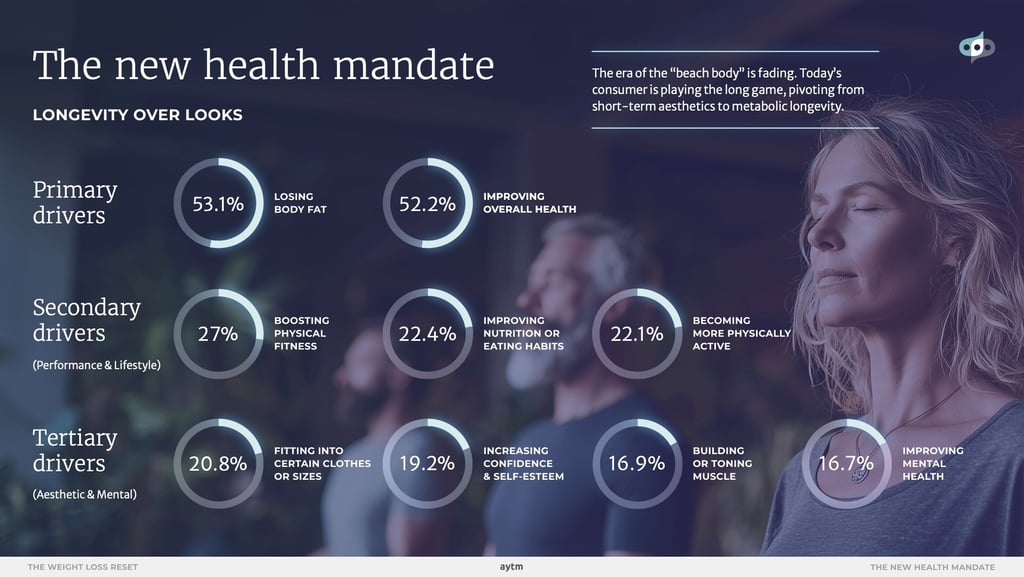
The top reasons people report trying to lose weight now center on health rather than appearance. Just over half (53.1%) say losing body fat is their primary goal, while 52.2% cite improving overall health. Performance and lifestyle goals follow, with 27.0% seeking to boost physical fitness, 22.4% aiming to improve nutrition habits, and 22.1% wanting to become more physically active.
Only about one in five respondents (20.8%) mention fitting into certain clothes or sizes as a motivator, suggesting the era of crash dieting for a beach body or special event is waning in favor of sustainable health improvements.
Diet Changes Lead the Way
When it comes to actual behavior change, diet dominates. An overwhelming 82.7% of respondents changed eating habits or adopted a diet plan, far outpacing those who started a new workout routine (38.3%). This disparity underscores a growing recognition that nutrition drives weight loss more effectively than exercise alone.
The most common changes are simple, repeatable adjustments: drinking more water (72.5%), eating more healthy foods (65.5%), cutting back on unhealthy foods (61.1%), changing snacking habits (57.7%), and adjusting portion sizes (54.9%). Nearly half (47.7%) report cooking at home more often, raising the competitive bar for both consumer packaged goods companies and quick-service restaurants.
The Snacking Battleground
Snacking behavior reveals clear winners and losers. More than half of respondents (53.2%) say they snack less than they used to. Among those still snacking, consumption patterns are rotating away from indulgent categories toward nutrient-dense options.
Consumers report cutting back most on sweet snacks (41.4%), frozen snacks (40.2%), and salty snacks (37.3%). Meanwhile, they're eating more fruits and vegetables (52.1%), protein snacks (42.4%), and dairy (25.5%).
Grocery stores remain the primary snack purchasing location (76.8%), followed by big-box retailers like Walmart and Target (65.6%). Convenience stores and gas stations still capture impulse purchases (26.2%). The median weekly spend on personal snacks sits at $11.21, with 65.7% of consumers keeping it under $20.
Home Cooking Intensifies Restaurant Competition
With 47.7% of respondents cooking or eating at home more often to control intake, restaurants face intensified competition from the home kitchen. To remain competitive, quick-service restaurants must compete on more than price alone. Protein content, ingredient transparency, and customization options are becoming baseline expectations rather than premium features.
GLP-1 Users Report Strong Satisfaction
Among respondents who report using prescription weight loss medications or supplements, 72.7% are taking a GLP-1 medication, and an impressive 80.6% plan to continue long-term. User sentiment skews strongly positive, with 53.3% reporting very positive experiences and 25.0% somewhat positive.
Many users attribute their satisfaction to reduced cravings and diminished "food noise." One respondent explained in an open-ended response that the medication "cut down on the food noise that I was having a hard time controlling. It has allowed me to regain control over my snacking, what I crave, and portions."
However, non-users remain divided. While 41.4% say they're familiar with GLP-1 medications, most are unlikely to try them in the near term, citing concerns about side effects and long-term safety. This hesitancy highlights the gap between current users' positive experiences and broader public perception.
Implications for Brands
These behavioral shifts carry significant implications across multiple industries. For grocery, snack, and beverage brands, winning now requires nutrient density and labeling clarity. Consumers are actively editing their pantries, and products with fast-to-understand nutritional information have a competitive edge.
Quick-service restaurants must elevate their value proposition beyond convenience and price. Protein content, ingredient transparency, and customization capabilities are no longer differentiators but essential features for competing with home-cooked meals.
Pharmaceutical companies face a different challenge. While adoption is strong among GLP-1 users, skepticism persists among non-users. Addressing concerns about side effects, safety, and long-term health impacts will determine whether adoption expands beyond early adopters.
"This research shows consumers editing their pantry with intent," said Stephanie Vance, VP of Customer Experience & Research Strategy at aytm. "They are cutting back on traditional indulgent snacks, leaning into protein and produce, and expecting more transparency in food labeling. At the same time, GLP-1 adoption is reshaping portion needs and product expectations. Brands that stay 'average' will feel the squeeze."
The survey was fielded online via PaidViewpoint on September 17, 2025, and includes self-reported responses from 1,000 U.S. adults ages 18 and older who tried to lose weight in the past six months.
Related Stories
Lotti Media © 2025-2026
Lotti MEDIA is your go-to source for multi-industry insights, innovation, and more.
Stay in the Know
Join our mailing list today.
Powered by: Lotti Communications